Machine Learning
Overview
- Machine Learning (ML) is not deeply tested in the CCP exam.
- You only need to understand main AWS ML services and their high-level use cases.
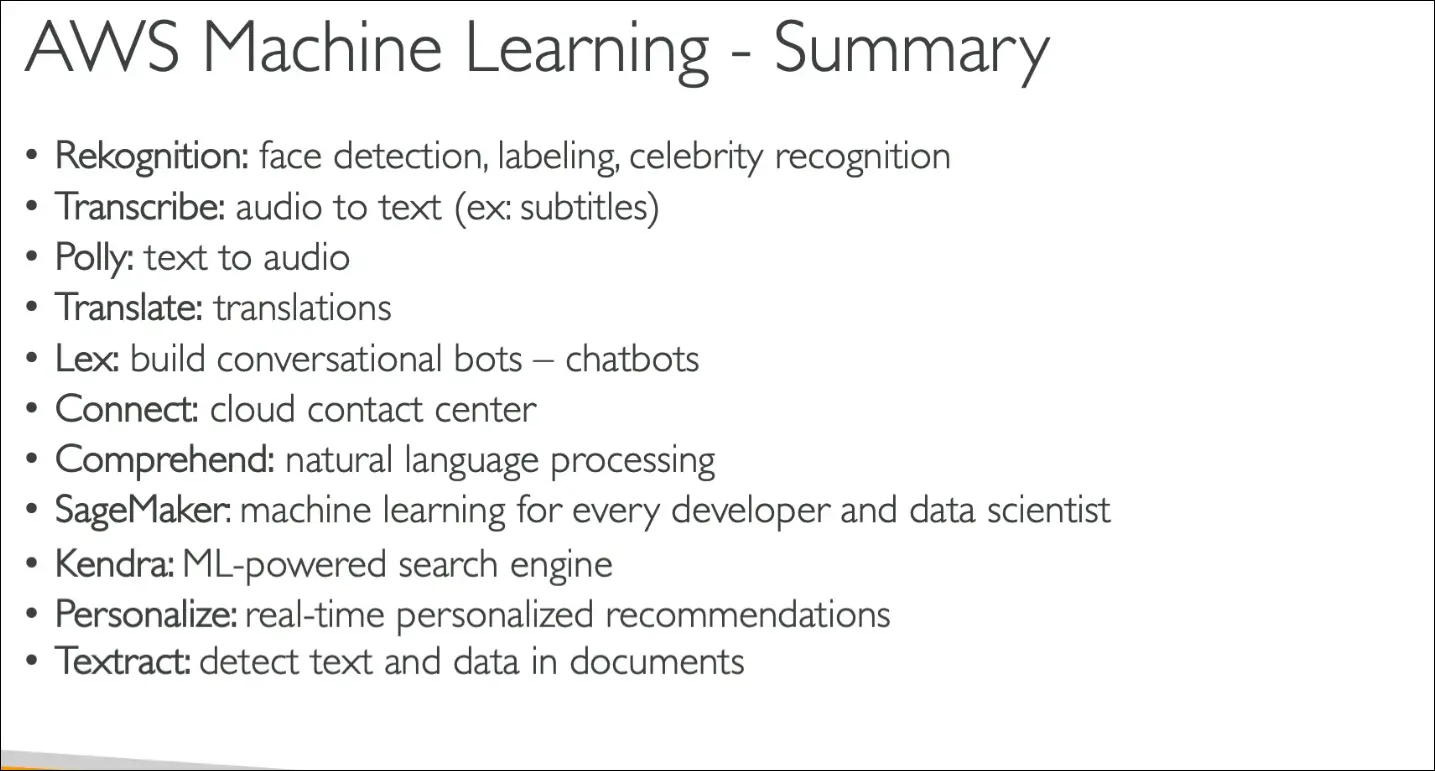
Amazon Rekognition
Definition: A machine learning-based image and video analysis service that can automatically detect and recognize objects, people, text, scenes, and activities.
Core Features / Capabilities:
- Object and Scene Detection: Identifies items in images or videos (e.g., person, dog, mountain bike).
- Facial Analysis: Detects faces and analyzes attributes like gender, age range, and emotion.
- Face Search and Verification: Compares faces for user verification or security applications.
- Celebrity Recognition: Identifies well-known people in images or videos.
- Text Detection: Extracts text from images (useful for reading signs, runner numbers, etc.).
- Content Moderation: Flags inappropriate or unsafe content.
- Pathing / Movement Tracking: Tracks object or person movements (e.g., in sports or surveillance).
Use Cases:
- Security systems (face recognition, identity verification)
- Media analysis (content tagging, moderation)
- Retail or events (counting people, analyzing demographics)
- Sports analytics (player movement tracking)
Exam Tip: Rekognition = Image and Video Analysis (Think “recognize” → detect faces, objects, and scenes).
Key Takeaway
For the exam, know what Rekognition does, its main use cases, and that it uses machine learning to analyze visual content. No need to memorize technical implementation details.
Amazon Transcribe
Overview
- Purpose: Converts speech to text automatically using machine learning.
- Technology Used: ASR (Automatic Speech Recognition) — a deep learning process for fast and accurate transcription.
Key Features
- Speech-to-Text Conversion
- Converts audio files or live streams into text transcripts.
- Common example: “Hello, my name is Stephane” becomes text instantly.
- PII Redaction
- Automatically removes Personally Identifiable Information (PII) such as:
- Names
- Ages
- Social Security Numbers
- Phone numbers
- Ensures privacy and compliance.
- Automatically removes Personally Identifiable Information (PII) such as:
- Automatic Language Identification
- Detects and handles multiple languages (e.g., English, French, Spanish) in one audio stream.
- Useful for multilingual customer service or media.
- Streaming and Batch Processing
- Supports real-time transcription (streaming audio).
- Also supports batch transcription for pre-recorded files.
Use Cases
- Customer Service Calls:
Convert call center recordings into searchable text for analysis and training. - Closed Captioning & Subtitling:
Automate caption generation for videos or live events. - Media Metadata Generation:
Create searchable archives by tagging speech content within media files.
Exam Tip
Remember:
Amazon Transcribe = Speech to Text
Think of it as the service for converting audio into readable text, with built-in PII protection and multilingual support.
Amazon Polly
Overview
- Purpose: Converts text into natural-sounding speech using deep learning.
- Opposite of Amazon Transcribe (Transcribe = speech to text, Polly = text to speech).
- Enables creation of talking applications or voice-enabled systems.
Key Features
- Text-to-Speech (TTS) Conversion
- Generates lifelike audio from written text.
- Example: Input “Hello, my name is Stephane” → Polly produces speech audio.
- Multiple Voices and Languages
- Supports many languages and different voice types (male, female, accent variations).
- Speech Engines
- Standard Engine: Produces more robotic voices (faster, lower cost).
- Neural Engine: Uses neural networks to create more natural and human-like voices.
- Customizable Output
- You can adjust tone, volume, speed, and pronunciation using Speech Synthesis Markup Language (SSML).
Use Cases
- Voice-Enabled Applications: Apps that “speak” to users (e.g., customer assistants, reading tools).
- Accessibility Tools: Helping visually impaired users access content.
- Content Narration: Generating audio versions of articles, e-learning materials, or blog posts.
- Interactive Voice Systems: IVRs or chatbots with realistic voices.
Exam Tip
Remember:
Amazon Polly = Text to Speech
Think “Polly talks.” It’s used to make applications that can speak naturally using deep learning.
Amazon Translate
Purpose:
A fully managed machine translation service that uses deep learning to translate text accurately and naturally between languages.
Key Features
- Automatic Language Translation: Converts text from one language to another.
- Localization: Helps make websites and applications accessible to international users by translating content into their native languages.
- High Volume Translation: Designed to handle large amounts of text efficiently.
- Neural Machine Translation (NMT): Uses advanced ML models for more context-aware and natural translations.
Common Use Cases
| Use Case | Description |
|---|---|
| Website Localization | Translate UI and content for global audiences |
| App Localization | Support multilingual apps |
| Document Translation | Convert manuals, user guides, and FAQs |
| Communication Tools | Enable multilingual chat or email systems |
Example
English: “Hi, my name is Stephen.”
- French: “Bonjour, je m’appelle Stephen.”
- Portuguese: “Olá, meu nome é Stephen.”
- Hindi: “नमस्ते, मेरा नाम स्टीफन है।”
Exam Tip
Remember:
Amazon Translate = neural machine translation service for text localization and multilingual support.
It focuses on accuracy, scalability, and real-time translation.
Amazon Lex and Amazon Connect
Amazon Lex
Purpose:
A service for building chatbots and voice assistants using the same technology that powers Amazon Alexa.
Key Features
- Automatic Speech Recognition (ASR): Converts spoken words into text.
- Natural Language Understanding (NLU): Understands intent and meaning behind user input.
- Conversational Interfaces: Enables development of chatbots or voice bots for websites, apps, and call centers.
- Integration: Works seamlessly with Amazon Connect, Lambda, and other AWS services.
Use Cases
| Use Case | Description |
|---|---|
| Chatbots | Customer support or FAQ automation |
| Voice Bots | Voice-based assistants for apps or websites |
| Call Center Bots | Handle user queries through speech |
| Task Automation | Booking, scheduling, or account lookup through chat or voice |
Example
User says: “I want to schedule a meeting tomorrow.”
- Lex converts speech → text (ASR).
- Understands intent: schedule meeting (NLU).
- Invokes AWS Lambda function to create the meeting in CRM.
Exam Tip
Amazon Lex = ASR + NLU
Used to build chatbots and voice-based automation.
Amazon Connect
Purpose:
A cloud-based contact center service for managing customer calls and interactions.
Key Features
- Virtual Contact Center: Receive calls, design contact flows, and manage interactions visually.
- No Upfront Cost: Pay-as-you-go pricing model, about 80% cheaper than traditional systems.
- Integrations: Works with CRMs, AWS Lambda, and other AWS services.
- Scalable and Managed: No infrastructure management required.
- Real-Time Analytics: Monitor and record customer interactions.
Example Workflow
- A customer calls a number managed by Amazon Connect.
- Lex listens and interprets the conversation (ASR + NLU).
- Lex invokes a Lambda function to process actions, e.g., scheduling appointments in a CRM.
- The workflow completes automatically without human intervention.

Exam Tip
Amazon Connect = Cloud Contact Center
Amazon Lex = Conversational AI service
Together, they enable intelligent, automated customer support systems.
Summary Table
| Service | Function | Use Case |
|---|---|---|
| Lex | Speech-to-text and intent understanding | Build chatbots, automate conversations |
| Connect | Cloud-based contact center | Handle and route customer calls |
Amazon Comprehend
Purpose:
A Natural Language Processing (NLP) service that uses machine learning to extract insights and relationships from text.
Key Characteristics
- Fully managed and serverless – no infrastructure to manage.
- Uses ML to understand text, uncover meaning, and detect relationships.
- Designed for unstructured data (emails, reviews, documents, etc.).
Core Capabilities
| Feature | Description |
|---|---|
| Language Detection | Identifies the language of a text sample. |
| Key Phrase Extraction | Finds important terms, places, people, or brands. |
| Entity Recognition | Detects entities like names, locations, organizations. |
| Sentiment Analysis | Determines whether the text is positive, negative, or neutral. |
| Syntax Analysis | Breaks text into tokens and parts of speech. |
| Topic Modeling | Groups large text collections by topic automatically. |
How It Works
- Input text or documents into Comprehend.
- Comprehend analyzes and structures the data using ML.
- Output includes detected sentiment, entities, and topics.
Common Use Cases
| Use Case | Description |
|---|---|
| Customer Feedback Analysis | Analyze reviews or support emails to detect satisfaction levels. |
| Business Insights | Understand what drives positive or negative experiences. |
| Content Categorization | Automatically group articles or documents by discovered topics. |
| Brand or Entity Tracking | Identify mentions of products, people, or places across datasets. |
Example Scenario
A company receives thousands of customer emails.
Using Amazon Comprehend, they can:
- Detect language automatically.
- Extract key phrases like “delivery delay” or “excellent service.”
- Perform sentiment analysis to see if customers are happy or upset.
- Group similar messages by topic for reporting.
Exam Tip
- Keyword: NLP → Amazon Comprehend
- Focus on: text analysis, sentiment detection, entity recognition, and topic grouping.
- Remember: It’s fully managed, serverless, and built for text understanding.
Amazon SageMaker
Purpose:
A fully managed service that helps developers and data scientists build, train, and deploy machine learning (ML) models quickly and efficiently.
Why SageMaker?
- Most other AWS AI/ML services (like Polly, Rekognition, Translate, etc.) solve specific ML problems.
- SageMaker is a general-purpose ML platform for creating your own custom ML models.
- It handles the end-to-end ML workflow — from data preparation to model deployment.
Key Features
| Step | Description |
|---|---|
| 1. Data Labeling | Identify and tag data (e.g., inputs and expected outputs). SageMaker Ground Truth can automate this. |
| 2. Model Building | Write and experiment with ML models using Jupyter notebooks. |
| 3. Model Training & Tuning | Train models on managed infrastructure. Automatically adjusts parameters for better accuracy. |
| 4. Model Deployment | Deploy trained models to scalable endpoints for real-time predictions (inference). |
End-to-End ML Workflow Example
Goal: Predict exam scores for AWS students.
- Collect Data: Experience, course time, practice exams.
- Label Data: Attach real exam results (scores).
- Build Model: Create a predictive model using SageMaker.
- Train & Tune: Improve model accuracy using SageMaker’s compute resources.
- Deploy: Use the model to predict new students’ scores.
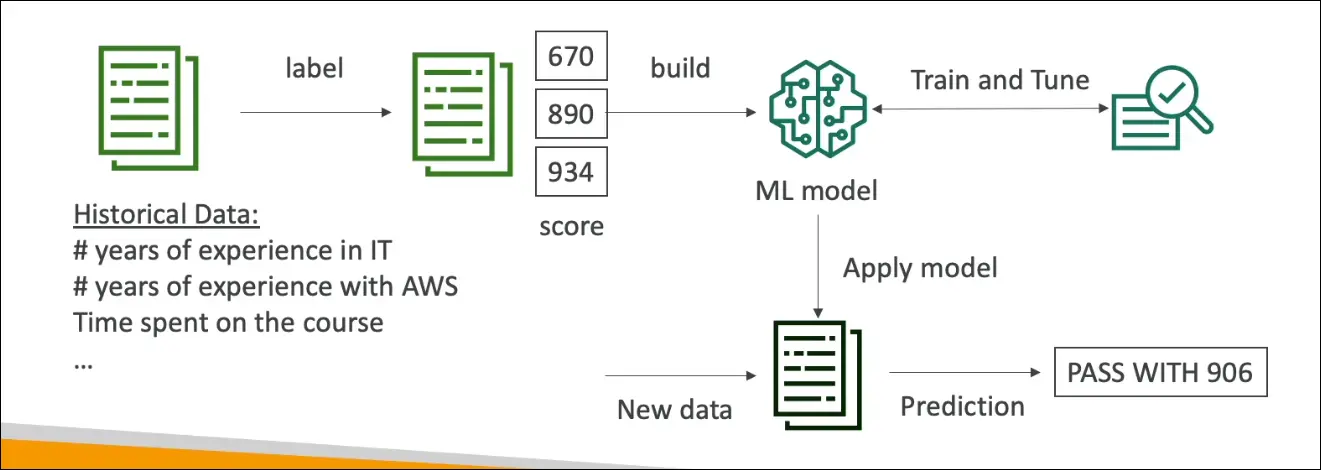
All these steps are managed inside Amazon SageMaker.
Benefits
- Fully managed: No need to provision or manage servers.
- Scalable: Automatically adjusts resources for training or inference.
- Integrated: Works seamlessly with S3 (data storage), Lambda, API Gateway, and CloudWatch.
- Cost-effective: Pay only for what you use during training or deployment.
Use Cases
- Predictive analytics (sales, churn, exam results).
- Fraud detection.
- Image or text classification.
- Custom recommendation engines.
Exam Tip
- Keyword: Custom ML model → Amazon SageMaker
- If the question mentions:
- Training models → SageMaker
- Deploying ML models → SageMaker
- End-to-end ML workflow → SageMaker
- Fully managed service for developers/data scientists, not for ready-made AI tasks.
Amazon Kendra
Purpose:
A fully managed, ML-powered enterprise search service that allows users to search through documents using natural language queries and get accurate answers, not just keyword matches.
Key Features
| Feature | Description |
|---|---|
| Document Search | Lets users search across large collections of documents like PDFs, Word files, HTML, PowerPoint, FAQs, etc. |
| Data Sources | Supports multiple sources such as S3, SharePoint, Salesforce, databases, and other enterprise systems. |
| Knowledge Index | Kendra creates an internal machine learning-powered index from all connected documents. |
| Natural Language Queries | Users can type questions like “Where is the IT support desk?” and get direct answers (e.g., “1st floor”) instead of document lists. |
| Incremental Learning | Improves search accuracy over time by learning from user feedback and behavior. |
| Custom Ranking & Filters | Results can be fine-tuned based on data importance, freshness, or custom business filters. |
Example Use Case
- A company stores thousands of documents (FAQs, policies, manuals).
- Employees ask, “What is the leave policy for contractors?”
- Amazon Kendra searches across all connected files and returns the exact answer, not just document titles.
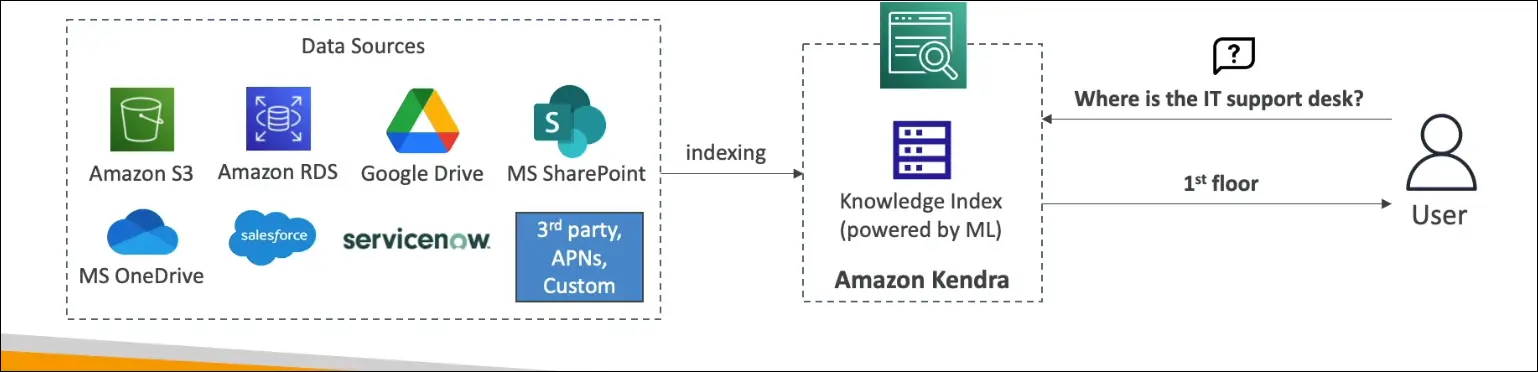
Benefits
- Fully managed (no infrastructure setup).
- Context-aware search using machine learning.
- Improves over time with feedback.
- Integrates easily with enterprise data sources.
Exam Tips
| Keyword in Question | AWS Service |
|---|---|
| “Search across documents” | Amazon Kendra |
| “Natural language search” | Amazon Kendra |
| “Enterprise knowledge base” | Amazon Kendra |
| “Find answers, not just keywords” | Amazon Kendra |
Remember:
If the exam question mentions document or knowledge search using natural language, the answer is Amazon Kendra.
Amazon Personalize
Purpose:
A fully managed machine learning service that lets you easily build real-time personalized recommendations for users — the same technology used by Amazon.com.
Key Features
| Feature | Description |
|---|---|
| Personalized Recommendations | Suggests products, content, or items tailored to each user’s behavior and preferences. |
| Real-Time Personalization | Generates recommendations dynamically as users interact with your app or website. |
| Input Data from S3 | Feeds in data such as user activity, purchase history, or product catalog stored in Amazon S3. |
| API Integration | Uses Amazon Personalize APIs to send data and receive personalized results in real time. |
| Fast Deployment | Takes days (not months) to implement — no need to manually build, train, or deploy ML models. |
| Omnichannel Use | Works across websites, mobile apps, SMS, and email for customized user engagement. |
Example Use Case
- A user buys gardening tools → Personalize recommends fertilizers or planters.
- Similar to Amazon.com suggesting “You might also like…” based on your purchase history.
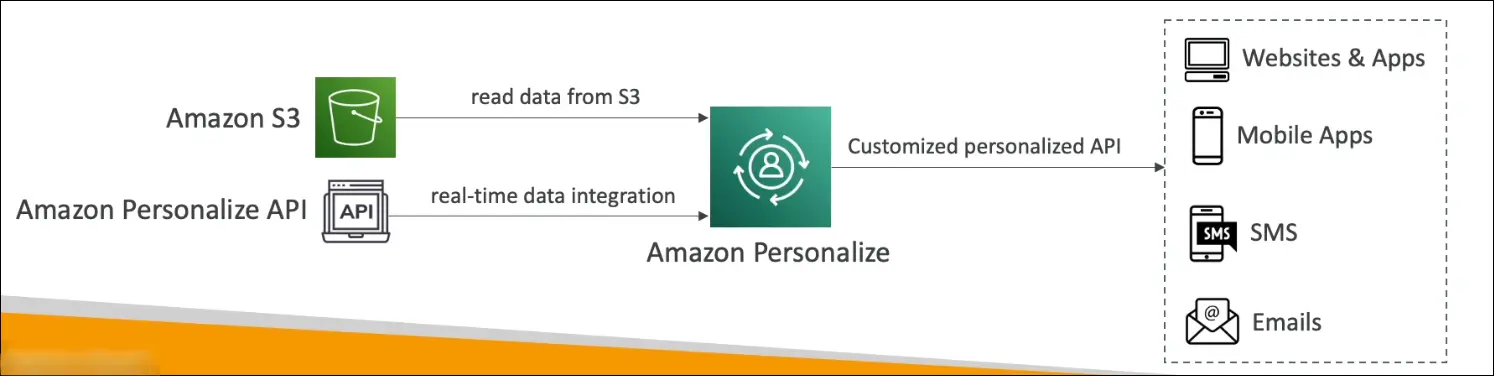
Common Industries
- Retail → Product recommendations
- Media & Entertainment → Movie or music suggestions
- E-commerce → Personalized shopping experience
- Marketing → Tailored email or SMS campaigns
Benefits
- Fully managed — no ML expertise required.
- Scalable — handles millions of users and products.
- Real-time predictions — updates instantly with user activity.
- Integrates easily with existing applications.
Exam Tips
| Keyword in Question | AWS Service |
|---|---|
| “Personalized recommendations” | Amazon Personalize |
| “Recommender system” | Amazon Personalize |
| “Customize marketing or user experience” | Amazon Personalize |
| “Used by Amazon.com for suggestions” | Amazon Personalize |
Memory Trick
P for Personalize = P for Personalized Product Picks
Amazon Textract
Amazon Textract is an AI and machine learning service that automatically extracts text, handwriting, and data from scanned documents such as PDFs or images.
It can identify and extract information from forms, tables, and structured documents—for example, fields like name, date of birth, or ID number from a driver’s license.
Use cases include:
- Finance: Processing invoices, receipts, and financial reports
- Healthcare: Extracting data from medical records and insurance claims
- Public Sector: Automating tax form, ID, and passport processing

It provides the extracted data in a machine-readable format, making document analysis faster and reducing manual data entry.
Summary